
The Complete Veterinary Guide to Mayo Scissor Types, Uses, and Mayo vs. Metzenbaum Scissors
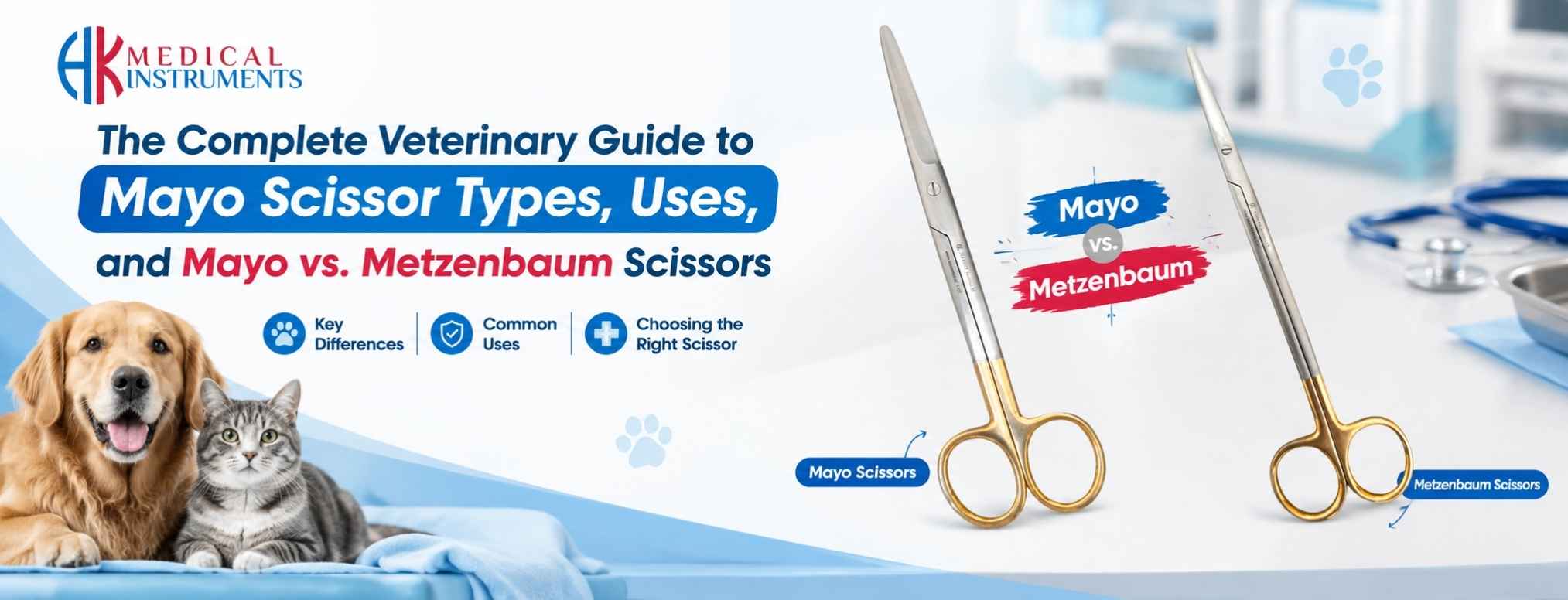
Mayo scissors are heavy-pattern surgical scissors with short, sturdy, blunt-tipped blades used to cut fascia, tendons, sutures, and other tough tissue. Named after brothers William and Charles Mayo of the Mayo Clinic, they come in straight and curved patterns and are a core instrument in veterinary spay, castration, orthopedic, and general soft-tissue surgery. This guide covers every mayo scissors type, how they compare to Metzenbaum scissors, and how to pick the right pattern for your clinic.
What Are Mayo Scissors?
Mayo scissors are a category of surgical scissor characterized by a roughly 1:1 blade-to-shank ratio, thick blunt/blunt tips, and a robust box-lock joint built to withstand repeated force. Unlike finer dissecting scissors, mayo surgical scissors are designed to cut, not just spread tissue, they're the instrument reached for when the tissue is too dense or fibrous for a delicate scissor to handle without damage.
In veterinary practice, mayo scissors show up constantly: opening the linea alba during a spay, trimming fascia during a castration, cutting suture material at the end of a procedure, and dividing thick connective tissue in orthopedic work. Because they take real abuse — cutting suture dulls edges faster than tissue dissection, clinics typically keep a dedicated "suture-cutting" mayo scissor separate from the one reserved for tissue, extending the working life of both.
Explore HK Medical Instruments' full range of veterinary Mayo scissors built for Canadian clinical use.
Types of Mayo Scissors: Straight, Curved, and Mayo-Stille
Mayo scissors aren't a single instrument, the pattern you choose changes what the scissor is good for. The three patterns every veterinary team should know are straight, curved, and Mayo-Stille.
Straight Mayo Scissors
Straight mayo scissors have blades that run in a direct line from the joint to the tip. This gives better mechanical leverage than a curved blade, which is why straight mayo scissors are the standard choice for cutting sutures and surface-level material rather than deep tissue work. Many surgeons keep a straight mayo scissor on the tray specifically as the "suture scissor" so the curved pair stays sharp for tissue.
HK Medical Instruments stocks straight mayo scissors in 14.5 cm and 17 cm lengths, with a Tungsten Carbide (TC) Gold edge option for clinics that want longer-lasting sharpness on high-use instruments.
Curved Mayo Scissors
Curved mayo scissors uses center on reaching and cutting dense tissue deeper in a surgical field — the curve follows the natural contour of the wound and improves visibility of the blade tips. This makes curved mayo scissors the preferred pattern for cutting fascia, uterine tissue, and thick muscle layers during spays, castrations, and other abdominal procedures, where a straight blade would obscure the surgeon's line of sight. The curve also allows slightly deeper penetration into a cavity without the shank getting in the way. Because the tips stay blunt, curved mayo scissors are considered safer near delicate structures than a sharp-tipped alternative, reducing the risk of accidentally nicking bowel, bladder, or vessels while dissecting or cutting fascia in a confined space.
Shop curved options including the 14.5 cm curved TC Gold and 17 cm curved TC Gold mayo scissors, or the standard stainless 17 cm curved pattern.
Mayo-Stille Scissors
Mayo-Stille scissors are a curved variant with offset shanks, which shift the surgeon's hand slightly off the cutting line for a clearer view of the tissue being cut. This makes the 16 cm curved Mayo-Stille scissor a good fit for procedures where high-leverage cutting of fascia or tough suture material needs to happen without the handles blocking the surgical view.
Left-Handed Mayo Scissors
Left-handed surgeons using right-handed scissors lose mechanical advantage and can struggle to see the cutting line clearly. HK Medical Instruments offers dedicated 17 cm left-hand curved and 17 cm left-hand straight mayo scissors so left-handed veterinary surgeons get the same natural grip and cutting control as their right-handed colleagues.
Mayo Scissors vs. Metzenbaum Scissors: What's the Difference?
The single most common question in the surgical tray is mayo scissors vs. Metzenbaum scissors, and the answer comes down to blade-to-shank ratio and the tissue each one is built to handle. Mayo scissors have short, thick blades roughly equal in length to the shank, built for cutting tough tissue and sutures. Metzenbaum scissors have long, slender shanks and short, delicate blades, built for blunt dissection of soft, fragile tissue like fat, bowel, and thin muscle. Using a Metzenbaum to cut suture material will dull and misalign its fine blades; using a Mayo on delicate tissue risks unnecessary crushing trauma. The rule of thumb: reach for Mayo on anything tough, and Metzenbaum on anything delicate.
| Feature | Mayo Scissors | Metzenbaum Scissors |
|---|---|---|
| Blade-to-shank ratio | ~1:1, thick blades | Long shank, short delicate blades |
| Best for | Fascia, tendons, sutures, dense tissue | Fat, bowel, thin muscle, delicate dissection |
| Cutting style | Sharp, forceful cutting | Blunt, precise dissection |
| Common lengths | 14.5 cm – 17 cm | 14.5 cm – 23 cm+ |
| Tip design | Blunt/blunt | Blunt/blunt, more tapered |
| Typical procedures | Spay, castration, orthopedic, general surgery | Abdominal, soft-tissue, fine dissection |
Both instruments have their place on the same tray, most spay and castration packs include both a mayo and a Metzenbaum scissor for exactly this reason. HK Medical Instruments carries a full line of Metzenbaum scissors alongside its mayo range, so clinics can outfit a complete tray from one supplier.
Mayo Dissecting and Suture Scissors: Clinical Uses in Veterinary Practice
"Mayo dissecting scissors" and "mayo suture scissors" usually describe the same instrument used for two different jobs on the same tray. As a dissecting scissor, the curved mayo pattern is used to bluntly separate tissue planes, closing the tips, inserting them into the tissue, and opening the blades to spread rather than cut. As a suture scissor, the straight mayo pattern is kept aside specifically for trimming ligatures and suture ends at the close of a procedure, since suture material dulls a fine edge far faster than tissue does.
Common veterinary applications include:
- Canine and feline spays/neuters — opening and closing the linea alba, cutting ligatures
- Castrations — cutting through fascia and the spermatic cord sheath
- General soft-tissue surgery — dividing fascia, cutting drains, trimming sutures
- Orthopedic procedures — cutting tough periosteum and ligamentous tissue
- Large-animal surgery — heavier-duty cutting where a delicate scissor would fail
Because mayo scissors are a workhorse instrument, most instrument packs, including HK Medical Instruments' canine and feline spay packs and general surgery pack, include at least one mayo scissor as standard.
How to Choose the Right Mayo Scissors for Your Practice
- Match the pattern to the primary use. Straight for suture-cutting and surface work; curved for fascia and deeper tissue; Mayo-Stille where an unobstructed view of the cutting line matters.
- Pick a length for your patient size. 14.5 cm (6") patterns suit small-animal work; 17 cm (6¾") gives more reach for larger patients or large-animal procedures.
- Decide on Tungsten Carbide inserts. TC Gold-edged mayo scissors hold an edge significantly longer under heavy suture-cutting use, which lowers your sharpening/replacement frequency over time.
- Keep tissue and suture scissors separate. Designating one mayo scissor for suture only protects the edge of the scissor you use on tissue.
- Confirm left- or right-hand fit for any surgeon who operates left-handed, a mismatched instrument slows the surgeon down and increases fatigue over a long surgical day.
Browse the complete Mayo scissors category to compare lengths, patterns, and TC Gold options side by side, or contact HK Medical Instruments for help outfitting a full surgical tray.
Care, Sterilization, and Sharpening
Mayo scissors are autoclavable stainless steel instruments, but a few habits extend their working life considerably:
- Rinse immediately after use to keep blood and tissue from drying in the box-lock joint.
- Clean ultrasonically before autoclaving to remove debris the naked eye misses.
- Lubricate the joint with surgical instrument milk after each sterilization cycle.
- Test the edge regularly — if the scissor "chews" gauze instead of cutting it cleanly, it needs sharpening.
- Never use a tissue-dedicated mayo scissor to cut suture — this is the single fastest way to dull a good pair of scissors.
Frequently Asked Questions
What are mayo scissors used for?
Mayo scissors are used to cut fascia, tendons, ligaments, sutures, and other tough or dense tissue during surgery. Curved mayo scissors are typically used deeper in a wound, while straight mayo scissors are used for surface-level cutting and trimming sutures.
What is the difference between mayo and Metzenbaum scissors?
Mayo scissors have short, thick blades for cutting tough tissue and sutures, while Metzenbaum scissors have long, slender blades built for delicate dissection of soft tissue. Mayo scissors should never be substituted for fine dissection work, and Metzenbaum scissors should never be used to cut suture.
When should I use curved vs. straight mayo scissors?
Use curved mayo scissors when cutting dense tissue deeper in a surgical field, since the curve improves visibility of the blade tips. Use straight mayo scissors for surface-level cutting and for trimming sutures, since the straight blade gives better mechanical leverage.
What is a Mayo-Stille scissor?
A Mayo-Stille scissor is a curved mayo pattern with offset shanks, which keeps the surgeon's hand out of the line of sight for a clearer view while cutting fascia or tough suture material.
Are mayo scissors used in veterinary surgery?
Yes. Mayo scissors are a standard instrument in veterinary spay, castration, general soft-tissue, and orthopedic surgery, and are included in most standard veterinary spay and general surgery instrument packs.
Why does my mayo scissor go dull so quickly?
The most common cause is using the same scissor for both tissue and suture-cutting. Suture material dulls an edge far faster than tissue does, keeping a dedicated suture-cutting mayo scissor solves this.
Final Thoughts
Choosing the right mayo scissor pattern, straight, curved, or Mayo-Stille, comes down to matching the instrument to the tissue and the procedure. For dense fascia and deep tissue, reach for a curved mayo; for sutures and surface work, keep a straight mayo on hand; and remember that a Metzenbaum, not a Mayo, belongs in your hand for delicate dissection.
HK Medical Instruments supplies veterinary-grade Mayo scissors, Metzenbaum scissors, and complete surgical packs to clinics across Canada. Shop the full Mayo scissors range or get in touch for help building out your surgical tray.


Leave a Comment