
Metzenbaum Scissors: The Complete Veterinary Guide to Uses, Sizes, and Metzenbaum vs. Mayo Scissors
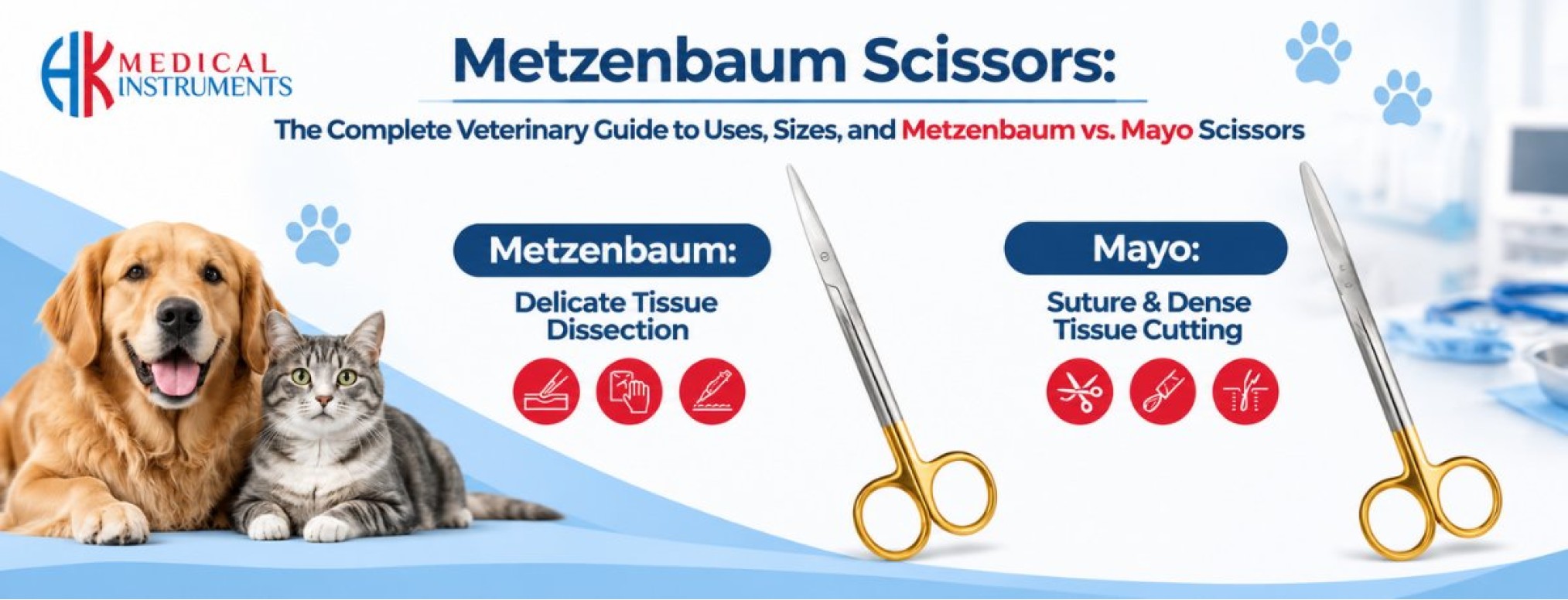
Metzenbaum scissors are delicate surgical scissors with a long shank-to-blade ratio and blunt tips, designed for fine dissection and cutting of soft, fragile tissue. Named after American surgeon Myron Firth Metzenbaum, they're a core instrument in veterinary surgery wherever tissue needs to be separated or cut with minimal trauma, fat, fascia-adjacent soft tissue, bowel, and thin muscle layers. This guide covers Metzenbaum scissors types and sizes, how they compare to Mayo scissors, and how to choose the right pair for your clinic.
What Are Metzenbaum Scissors?
Metzenbaum scissors are a category of surgical scissor built around a long, slender shank and short, delicate blades, the opposite proportions of a Mayo scissor. The blades are almost always blunt-tipped, which lets a surgeon use the closed tips to bluntly separate tissue planes, not just cut them, reducing the risk of damaging structures underneath. This dual role, fine cutting and blunt dissection, is what makes Metzenbaum scissors one of the most frequently used instruments in soft-tissue surgery.
In veterinary practice, Metzenbaum scissors are the go-to instrument for anything delicate: dissecting around organs, freeing adhesions, separating fat from fascia, and opening tissue planes where a heavier instrument like a Mayo scissor would crush or tear rather than cleanly separate. Because the blades are fine, Metzenbaum scissors should never be used to cut suture material or heavy fascia, doing so dulls and misaligns the delicate edge quickly.
Explore HK Medical Instruments' full range of veterinary Metzenbaum scissors built for Canadian clinical use.
Metzenbaum Scissors: Curved vs. Straight
Like most surgical scissor patterns, Metzenbaum scissors come in curved and straight versions, and the choice affects both visibility and reach.
Curved Metzenbaum scissors are the more commonly used pattern in general veterinary surgery. The curve follows the contour of the surgical field, keeping the blade tips visible during dissection and making it easier to work around organs and curved anatomical structures without the shank obstructing the view.
Straight Metzenbaum scissors are used for more superficial work, where a direct line of cut is more useful than following a contour — for example, opening tissue planes near the surface of an incision.
Both patterns are available with standard stainless jaws or Tungsten Carbide (TC) Gold inserts, which hold a sharper edge longer under repeated sterilization — important for an instrument whose entire value lies in a fine, precise cutting edge.
Metzenbaum Scissors Sizes
Metzenbaum scissors are sized by total instrument length, and the right size depends on patient size and how deep the surgical field is:
- 11.5–14.5 cm (4.5"–5.75") — feline and small-animal procedures, where a shorter instrument gives tighter control in a smaller field
- 17–18 cm (7") — the general veterinary standard for canine soft-tissue surgery
- 20 cm+ (8"+) — deeper fields and large-animal procedures requiring extra reach
A longer-shanked variant, sometimes called a Metzenbaum-Nelson or Nelson-Metzenbaum scissor, extends the shank further for very deep or narrow surgical fields, such as thoracic or deep abdominal work.
Mayo Scissors vs. Metzenbaum Scissors: What's the Difference?
Mayo scissors vs. Metzenbaum scissors is one of the most common questions on a surgical tray, and the two instruments are built for opposite jobs. Metzenbaum scissors have a long shank and short, delicate blades, designed for blunt dissection and cutting of soft, fragile tissue. Mayo scissors have a roughly 1:1 blade-to-shank ratio and thick, sturdy blades, designed for cutting tough tissue, fascia, and sutures. Using a Metzenbaum to cut suture material will dull and misalign its fine blades; using a Mayo on delicate tissue risks unnecessary crushing trauma. The rule of thumb: reach for Metzenbaum on anything delicate, and Mayo on anything tough.
| Feature | Metzenbaum Scissors | Mayo Scissors |
|---|---|---|
| Blade-to-shank ratio | Long shank, short delicate blades | ~1:1, thick blades |
| Best for | Fat, bowel, thin muscle, delicate dissection | Fascia, tendons, sutures, dense tissue |
| Cutting style | Blunt, precise dissection | Sharp, forceful cutting |
| Common lengths | 11.5 cm – 23 cm+ | 14.5 cm – 17 cm |
| Tip design | Blunt/blunt, more tapered | Blunt/blunt |
| Typical procedures | Abdominal, soft-tissue, fine dissection | Spay, castration, orthopedic, general surgery |
Both instruments typically sit on the same tray — most spay and castration packs include both a Metzenbaum and a Mayo scissor for exactly this reason. HK Medical Instruments carries a full line of Mayo scissors alongside its Metzenbaum range, so clinics can outfit a complete tray from one supplier.
Clinical Uses in Veterinary Practice
Metzenbaum scissors earn their place on nearly every soft-tissue surgical tray:
- Canine and feline spays/neuters — dissecting around the ovarian pedicle and uterine body, separating fat from fascia
- Abdominal exploratory surgery — freeing adhesions and dissecting around organs with minimal trauma
- General soft-tissue surgery — mass removals, hernia repair, and any procedure requiring delicate tissue separation
- Thoracic and deep-field procedures — longer-shanked Metzenbaum-Nelson variants reach tissue planes a standard length can't
- Large-animal surgery — larger Metzenbaum patterns for delicate dissection in bigger surgical fields
Because Metzenbaum scissors are such a core instrument, most standard instrument packs — including HK Medical Instruments' canine and feline spay packs — include a Metzenbaum scissor alongside the Mayo scissor as standard.
How to Choose the Right Metzenbaum Scissors for Your Practice
- Match the pattern to the field. Curved for most general soft-tissue dissection; straight for superficial, direct-line cutting.
- Pick a length for your patient size and field depth. Shorter lengths (11.5–14.5 cm) for feline/small-animal work; longer lengths (17 cm+) for canine and large-animal procedures; Metzenbaum-Nelson variants for deep or narrow fields.
- Decide on Tungsten Carbide inserts. TC Gold-edged Metzenbaum scissors hold a fine edge longer under repeated sterilization, which matters more for a delicate instrument than for a heavy-duty one.
- Never substitute a Metzenbaum for a Mayo. Keep delicate dissection and tough-tissue/suture cutting on separate instruments to protect both edges.
- Confirm left- or right-hand fit for any surgeon who operates left-handed, so hand position and visibility stay natural throughout the procedure.
Browse the complete Metzenbaum scissors category to compare lengths, patterns, and TC Gold options side by side, or contact HK Medical Instruments for help outfitting a full surgical tray.
Care, Sterilization, and Sharpening
Metzenbaum scissors are autoclavable stainless steel instruments, but because their value lies entirely in a fine edge, a few habits matter more here than on heavier instruments:
- Never use Metzenbaum scissors to cut suture, drains, or fascia — this is the single fastest way to dull and misalign the fine blades.
- Rinse immediately after use to prevent blood and tissue drying in the delicate box-lock joint.
- Clean ultrasonically before autoclaving to remove debris from the fine jaw serrations.
- Lubricate the joint with surgical instrument milk after each sterilization cycle.
- Test the edge regularly on a soft material — if it crushes rather than cuts cleanly, it needs sharpening or replacement.
Frequently Asked Questions
What are Metzenbaum scissors used for?
Metzenbaum scissors are used for delicate tissue dissection and cutting of soft, fragile tissue such as fat, bowel, and thin muscle. Their blunt tips also allow them to be used to bluntly separate tissue planes without cutting.
What is the difference between Metzenbaum and Mayo scissors?
Metzenbaum scissors have a long shank and short, delicate blades built for fine dissection, while Mayo scissors have thick, sturdy blades built for cutting tough tissue and sutures. Metzenbaum scissors should never be used to cut suture, and Mayo scissors should not be used for fine dissection.
Should I use curved or straight Metzenbaum scissors?
Curved Metzenbaum scissors are the more common choice for general dissection, since the curve keeps the blade tips visible while following the contour of the surgical field. Straight Metzenbaum scissors suit more superficial, direct-line cutting.
What is a Metzenbaum-Nelson scissor?
A Metzenbaum-Nelson (or Nelson-Metzenbaum) scissor is a longer-shanked variant of the standard Metzenbaum pattern, built to reach deep or narrow surgical fields such as thoracic or deep abdominal work.
Are Metzenbaum scissors used in veterinary surgery?
Yes. Metzenbaum scissors are a standard instrument in veterinary spay, abdominal, and general soft-tissue surgery, and are included in most standard veterinary spay and general surgery instrument packs.
Why do my Metzenbaum scissors go dull or misaligned so quickly?
The most common cause is using them to cut suture, drains, or tough fascia — jobs that belong to a Mayo scissor. Reserving Metzenbaum scissors strictly for delicate tissue dissection preserves the fine edge much longer.
Final Thoughts
Metzenbaum scissors earn their place on the tray through precision, not power — their long shank and delicate blades are built for separating and cutting fragile tissue with minimal trauma. Keep them reserved for that job, pair them with a Mayo scissor for anything tough, and choose curved or straight based on whether you need to follow a contour or cut a straight line.
HK Medical Instruments supplies veterinary-grade Metzenbaum scissors, Mayo scissors, and complete surgical packs to clinics across Canada. Shop the full Metzenbaum scissors range or get in touch for help building out your surgical tray.