
Ultimate Guide to Mayo-Hegar Needle Holders
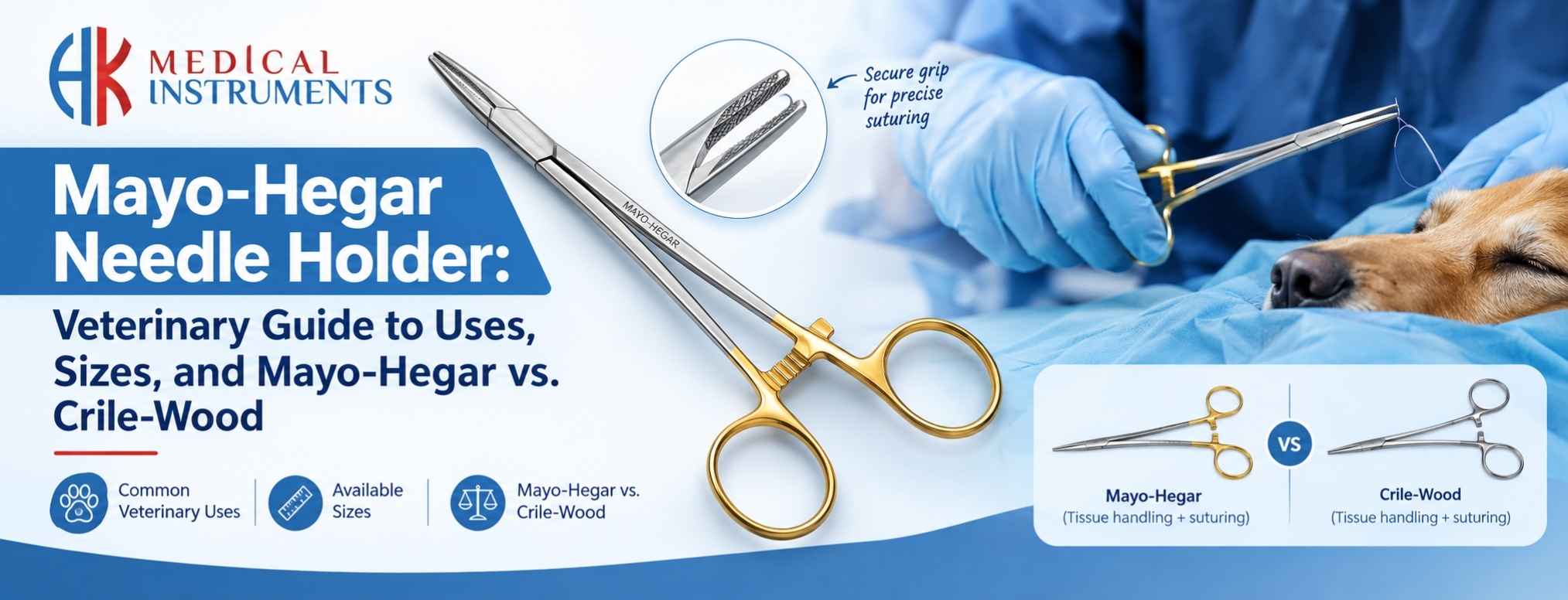
A Mayo-Hegar needle holder is a ratcheted, finger-ring surgical instrument with short, wide, serrated jaws used to grip and drive a suturing needle through tissue. It's the standard needle holder for general veterinary surgery, built to handle medium-to-heavy needles and heavier suture material without the jaw flexing or the needle rotating. This guide covers Mayo-Hegar sizes and materials, how it compares to the Crile-Wood and Olsen-Hegar needle holders, and how to choose the right one for your practice.
What Is a Mayo-Hegar Needle Holder?
The Mayo-Hegar needle holder takes its name from the Mayo pattern of surgical instrument and gynecologist Alfred Hegar, whose instrument designs shaped much of modern gynecological and general surgery. Structurally, it's built like a heavy-duty needle holder: two finger-ring handles joined by a box-lock, ending in short, thick jaws with cross-hatched serrations and a central groove that keeps the needle from rotating under tension. A ratchet mechanism near the handles locks the jaws shut, freeing the surgeon's grip strength for the actual suturing motion rather than for holding the needle in place.
Because the jaws are wide and only mildly tapered, the Mayo-Hegar is built for medium to heavy needles and general-purpose suture sizes — it's the needle holder reached for in routine spays, castrations, and general soft-tissue closure, rather than fine ophthalmic or microsurgical work.
Browse HK Medical Instruments' Mayo-Hegar needle holders stocked in Canada in both standard stainless and Tungsten Carbide (TC) Gold jaw options.
Mayo-Hegar Needle Holder Sizes and Jaw Materials
Mayo-Hegar needle holders are sized by overall instrument length, with the right length depending on patient size and how deep the surgical field is:
- 12.5–14 cm (5") — small-animal and feline work, where a shorter reach gives tighter hand control
- 16–18 cm (6–7") — the general-purpose veterinary standard, suited to canine spays, castrations, and routine soft-tissue closure
- 20 cm+ (8") — large-animal and deeper-field procedures where extra reach is needed
Jaw material is the other key decision. Standard stainless steel jaws are cost-effective and reliable for moderate caseloads. Tungsten Carbide (TC) insert jaws — identifiable by their gold-plated handles — hold a firm grip on the needle far longer under repeated sterilization and daily use, and the inserts can be replaced rather than retiring the whole instrument once they wear. For a clinic running several suturing cases a day, TC Gold jaws typically pay for themselves in reduced replacement frequency.
Browse the full size and jaw-material range on the Mayo-Hegar needle holder category page.
Mayo-Hegar vs. Crile-Wood Needle Holder: What's the Difference?
Mayo-Hegar vs. Crile-Wood comes down to jaw width and the needle sizes each is built to handle. The Mayo-Hegar has short, wide, mildly tapered jaws designed for medium-to-heavy needles and general tissue closure. The Crile-Wood has longer, finer, more gently tapered jaws designed for smaller needles and lighter suture — it's the instrument of choice when the surgical field calls for more finesse than the Mayo-Hegar's broader jaw can provide. Using a Crile-Wood on a heavy needle risks bending its finer tips; using a Mayo-Hegar on delicate suture gives less tactile precision than the job calls for.
| Feature | Mayo-Hegar Needle Holder | Crile-Wood Needle Holder |
|---|---|---|
| Jaw design | Short, wide, mildly tapered | Longer, finer, gently tapered |
| Best for | Medium-to-heavy needles, general closure | Small-to-medium needles, finer suturing |
| Typical use | General surgery, spay/neuter, routine closure | Cardiovascular, fine soft-tissue, delicate fields |
| Grip strength | Strong grip on heavier needles | More precise control, lighter needle grip |
| Common lengths | 12.5 cm – 20 cm+ | 15 cm – 20 cm |
| Jaw inserts | Stainless or TC Gold | Stainless or TC Gold |
Most practices keep both on hand: a Mayo-Hegar as the general-purpose workhorse, and a Crile-Wood reserved for finer suturing where the Mayo-Hegar's wider jaw would be overkill.
Mayo-Hegar vs. Olsen-Hegar: A Related Choice Worth Knowing
A comparison worth making alongside Crile-Wood is Mayo-Hegar vs. Olsen-Hegar, since the two look similar but serve different workflows. The Olsen-Hegar needle holder integrates a scissor blade into the base of the jaws, letting a surgeon hold, drive, and cut suture with one instrument — useful when operating without an assistant. The Mayo-Hegar has no cutting blade, which means a slightly cleaner, uninterrupted jaw line but requires a separate scissor for cutting suture.
HK Medical Instruments' own canine and feline spay packs are built around a TC Gold Olsen-Hegar for exactly this reason — it reduces the number of instruments on a routine spay tray. Clinics that prefer to keep needle-holding and suture-cutting as separate, dedicated instruments should reach for the Mayo-Hegar instead.
Clinical Uses in Veterinary Practice
The Mayo-Hegar needle holder is a tray staple across routine and advanced veterinary procedures:
- Canine and feline spays/neuters — driving the needle through the linea alba and subcutaneous closure layers
- Castrations — closing the incision and tying off ligatures
- General soft-tissue surgery — routine wound closure, hernia repair, mass removal sites
- Orthopedic procedures — closing fascia and periosteum with heavier suture
- Large-animal surgery — handling the larger needles and heavier suture gauges common in bovine and equine work
Because it's such a core instrument, a Mayo-Hegar (or its scissor-integrated cousin, the Olsen-Hegar) appears in nearly every standard surgical pack, including HK Medical Instruments' canine spay and feline spay kits.
How to Choose the Right Needle Holder for Your Practice
- Match jaw width to needle size. Heavy or medium needles → Mayo-Hegar. Fine, delicate needles → Crile-Wood.
- Decide if an integrated scissor helps your workflow. Solo or assistant-light procedures often benefit from an Olsen-Hegar instead of a separate Mayo-Hegar and scissor pair.
- Choose jaw material based on caseload. High-volume clinics recoup the cost of TC Gold jaws through fewer replacements and more consistent grip.
- Size for the patient and field depth. Shorter lengths for feline/small-animal work; longer lengths for canine, large-animal, or deeper surgical fields.
- Keep a dedicated instrument for fine work. Don't substitute a Mayo-Hegar for delicate suturing — a Crile-Wood protects both the needle and the suture line.
Browse the complete Mayo-Hegar needle holder range, or contact HK Medical Instruments for help specifying a full surgical tray.
Care and Maintenance
- Check the jaws regularly by test-gripping an appropriately sized needle — if it rotates under light pressure, the serrations or TC inserts need attention.
- Clean ultrasonically before autoclaving to remove debris from the fine jaw serrations.
- Lubricate the box-lock joint after each sterilization cycle to keep the ratchet action smooth.
- Never force an oversized needle into the jaws — this is the most common cause of a sprung or misaligned box-lock.
- Replace TC inserts rather than the whole instrument once grip strength noticeably declines, which is one of the main cost advantages of TC Gold jaws.
Frequently Asked Questions
What is a Mayo-Hegar needle holder used for?
A Mayo-Hegar needle holder is used to grip and drive a suturing needle through tissue during surgery. Its wide, mildly tapered jaws make it best suited to medium and heavy needles in general veterinary surgery, including spays, castrations, and routine soft-tissue closure.
What is the difference between a Mayo-Hegar and a Crile-Wood needle holder?
The Mayo-Hegar has shorter, wider jaws built for medium-to-heavy needles and general closure, while the Crile-Wood has longer, finer, more gently tapered jaws built for smaller needles and more delicate suturing.
Is a Mayo-Hegar or Crile-Wood better for veterinary spays?
A Mayo-Hegar is generally the better fit for routine canine and feline spays, since its wider jaws handle the medium-to-heavy needles typically used for linea alba and subcutaneous closure. A Crile-Wood is reserved for finer suturing within the same procedure if needed.
What's the difference between a Mayo-Hegar and an Olsen-Hegar needle holder?
An Olsen-Hegar has an integrated scissor blade at the base of the jaws, letting a surgeon hold, drive, and cut suture with a single instrument. A Mayo-Hegar has no cutting blade and requires a separate scissor for trimming suture.
What sizes does a Mayo-Hegar needle holder come in?
Mayo-Hegar needle holders typically range from around 12.5 cm (5") for small-animal and feline work up to 20 cm (8") or longer for large-animal and deep-field procedures, with 16–18 cm being the general veterinary standard.
Are Tungsten Carbide (TC) jaws worth it on a Mayo-Hegar?
For clinics with moderate to high surgical volume, TC Gold jaw inserts hold their grip on the needle significantly longer than standard stainless jaws and can be replaced individually, which usually offsets the higher upfront cost over the life of the instrument.
Final Thoughts
Choosing between a Mayo-Hegar, Crile-Wood, and Olsen-Hegar needle holder comes down to needle size, how much precision the procedure demands, and whether an integrated suture-cutting blade fits your workflow. For routine veterinary general surgery, the Mayo-Hegar remains the dependable default, reserve the Crile-Wood for finer work and consider the Olsen-Hegar when you want fewer instruments on the tray.
HK Medical Instruments supplies Mayo-Hegar, Olsen-Hegar, and a full range of veterinary needle holders and surgical packs to clinics across Canada. Shop the Mayo-Hegar needle holder range or get in touch for help building out your surgical tray.
Leave a Comment