
Castroviejo Needle Holder: Definition, Uses, Curved vs. Straight and Price
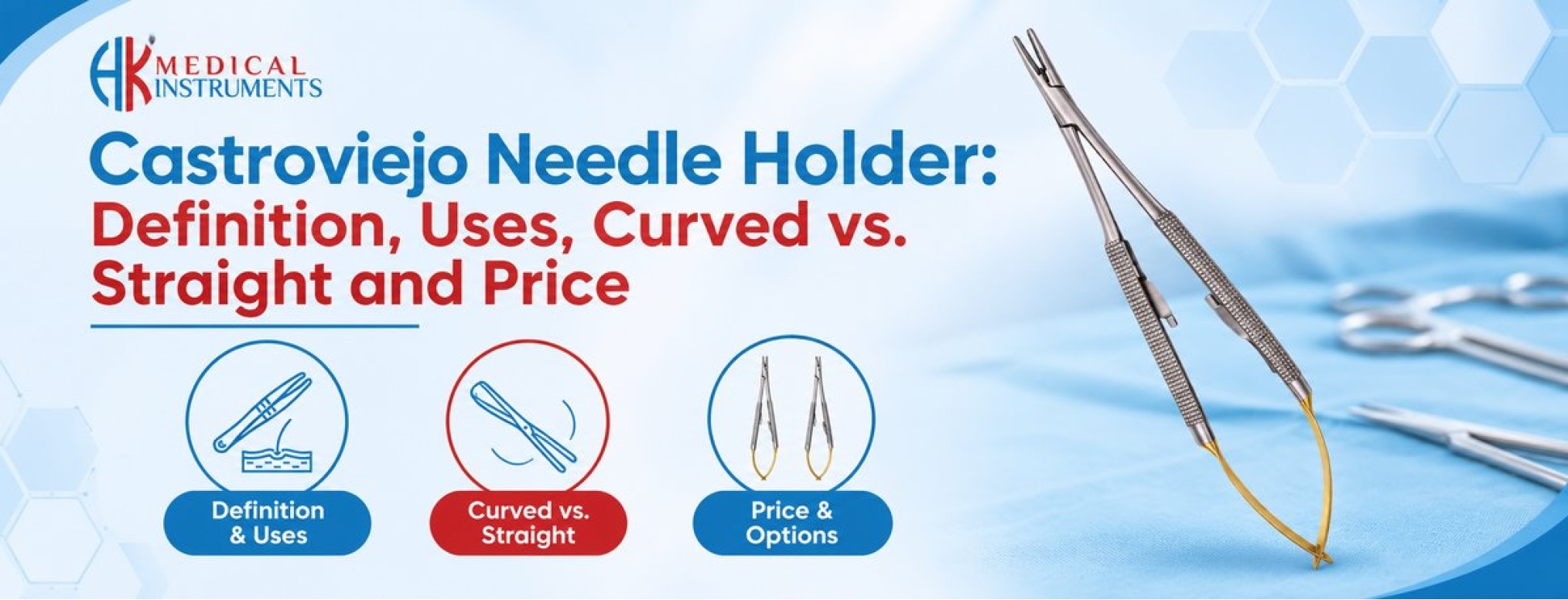
A Castroviejo needle holder is a fine, spring-handled microsurgical needle holder that is held like a pen and used to grip and drive very small suture needles through delicate tissue. Named after eye surgeon Ramón Castroviejo, it's the standard needle holder for ophthalmic surgery and other fine suturing in veterinary practice. This guide covers the Castroviejo needle holder definition, its uses, curved vs. straight patterns, price, and how to choose the right one for your clinic.
What Is a Castroviejo Needle Holder? (Definition)
By definition, a Castroviejo needle holder is a needle holder with no finger rings. Two spring handles meet at a pivot and end in short, very fine jaws. Squeezing the handles closes the jaws, and releasing them lets the spring open the jaws again. Most patterns add a small latch between the handles that locks the jaws on the needle and frees it with a second light squeeze.
The instrument was designed by Ramón Castroviejo (1904–1987), a Spanish-American ophthalmologist remembered for advancing corneal transplantation. His U.S. patent for the needle holder was filed in 1950 and granted in 1953. It describes a holder that works with or without the lock and is narrow enough to rotate in the fingers, the same features that define it today.
Explore HK Medical Instruments' range of veterinary Castroviejo needle holders stocked for Canadian clinics.
Castroviejo Needle Holder Uses
Castroviejo needle holder uses all share one requirement: placing fine suture precisely in tissue that tears easily. In veterinary practice, that means:
- Corneal surgery — repairing lacerations and securing grafts, typically with 8-0 to 9-0 suture under magnification
- Conjunctival surgery — placing conjunctival grafts and flaps over corneal defects
- Eyelid procedures — entropion correction, eyelid mass removal, and laceration repair with suture around 6-0
- Other microsurgery — the same pattern is used for vascular, plastic, and dental suturing in human medicine
Veterinary ophthalmic references pair the Castroviejo with suture from about 5-0 down to 10-0. Anything heavier belongs in a ring-handled instrument such as a Mayo-Hegar needle holder.
Castroviejo Needle Holder: Curved vs. Straight
Castroviejo needle holders come in curved and straight patterns, and the choice is about what you can see while you suture.
A curved Castroviejo needle holder has jaws that bend away from the line of the handle. The globe is spherical, so a straight instrument can put the surgeon's hand between the eye and the needle. Curved tips approach from the side and keep the point of needle entry in view, which also helps in deep or confined fields.
A straight Castroviejo needle holder keeps the tips in line with the handle. Most surgeons prefer it for flat, directly visible surfaces such as eyelid skin, and it's the usual first purchase.
| Feature | Curved Castroviejo | Straight Castroviejo |
|---|---|---|
| Jaw shape | Tips angled off the handle line | Tips in line with the handle |
| Best for | Suturing around the globe, deep or confined fields | Flat, directly visible surfaces |
| Visibility | Hand stays out of the line of sight | Direct view of an open field |
| Typical procedures | Corneal and conjunctival suturing | Eyelid closure, general fine suturing |
| HK options | 13 cm, stainless | 13 cm, stainless or TC Gold |
Many veterinary ophthalmic surgeons keep both: the 13 cm straight Castroviejo for flat surfaces and the 13 cm curved Castroviejo where anatomy would block the view.
Castroviejo Needle Holder Price
Castroviejo needle holder price depends on steel and finish quality, jaw material, the lock, and how precisely the tips meet. Online, economy imports start at roughly US$25–45, while premium German operating-room patterns run about US$370–640 each.
At HK Medical Instruments, pricing at the time of writing is:
- 13 cm straight, stainless — CAD $90
- 13 cm curved, stainless — CAD $90
- 13 cm straight, TC Gold — CAD $150
- Veterinary Eye Pack (7 Pcs) — CAD $360, including a locking 13 cm straight Castroviejo
Tungsten Carbide (TC) costs more upfront, but Castroviejo tips are so fine that there is little steel to absorb wear. Once plain stainless jaws polish smooth, they stop holding micro needles altogether, so TC Gold usually pays for itself in clinics that suture eyes regularly.
How to Choose the Right Castroviejo Needle Holder
- Match the instrument to the suture. Fine suture around 6-0 to 9-0 calls for a Castroviejo; heavier needles need a ring-handled holder.
- Pick the pattern for the surface. Straight for flat, visible tissue; curved for working around the globe.
- Choose jaw material by caseload. Stainless suits occasional eyelid work; TC Gold suits regular corneal or intraocular surgery.
- Decide how you'll use the lock. Locking reduces finger fatigue in long closures; some surgeons suture unlocked on the finest tissue.
- Size for control. A 13–14 cm body is the common ophthalmic length, light enough to roll between the fingers.
Browse the complete Castroviejo needle holder category to compare straight, curved, and TC Gold options side by side, or contact HK Medical Instruments for help outfitting an eye surgery tray.
Care and Maintenance
Castroviejo tips are precision components, so a few habits protect them:
- Never grip heavy needles or use the instrument as a general grasper — this springs the fine jaws.
- Protect the tips with tip guards and keep the instrument apart from heavier ones during cleaning.
- Clean promptly and lubricate the pivot before autoclaving.
- Test the grip regularly with a fine needle — if it rotates under light pressure, the jaws need attention.
Frequently Asked Questions
What is a Castroviejo needle holder used for?
A Castroviejo needle holder is used to hold and drive very small suture needles in delicate tissue, mainly in corneal, conjunctival, and eyelid surgery, and in vascular, plastic, and dental microsurgery.
What is the definition of a Castroviejo needle holder?
It is a microsurgical needle holder with spring handles instead of finger rings, fine jaws, and usually a latch lock. It is held like a pen and named after ophthalmologist Ramón Castroviejo.
When should I use a curved Castroviejo needle holder?
Choose a curved Castroviejo needle holder when suturing around the curvature of the globe or in a deep, confined field. The curved tips keep your hand out of the line of sight so the needle stays visible.
How much does a Castroviejo needle holder cost?
Prices range from roughly US$25–45 for economy imports to several hundred dollars for premium German patterns. HK Medical Instruments lists 13 cm models at CAD $90 in stainless and CAD $150 in TC Gold.
How do you hold a Castroviejo needle holder?
Use a pencil grip, with the handles resting between the thumb, index, and middle fingers. Rolling the instrument in the fingers drives the needle along its curve without moving the wrist.
What is the difference between a Castroviejo and a Mayo-Hegar needle holder?
A Castroviejo has spring handles, a pen grip, and fine jaws for micro needles. A Mayo-Hegar has finger rings, a ratchet, and wide jaws for the medium-to-heavy needles used in general surgery.
Final Thoughts
The Castroviejo needle holder earns its place through control, not force. Choose straight for flat, visible surfaces, curved for working around the globe, and TC Gold if eye surgery is a regular part of your caseload.
HK Medical Instruments supplies Castroviejo needle holders, eye instruments, and complete surgical packs to veterinary clinics across Canada. Shop the full Castroviejo needle holder range or get in touch for help building out your surgical tray.